



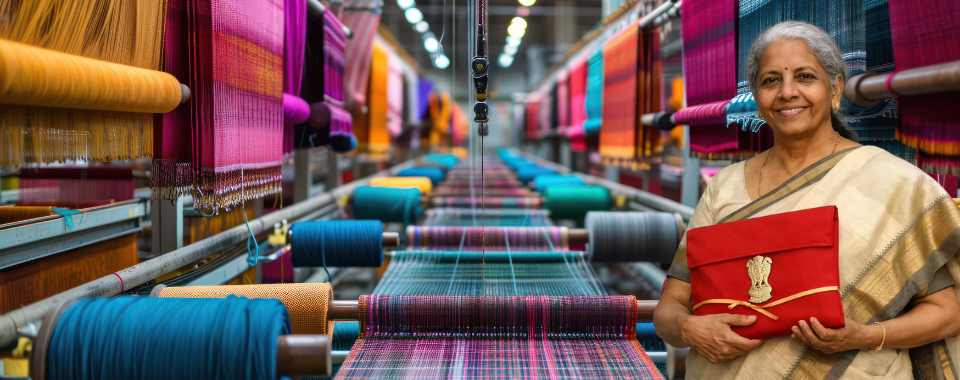
The Union Budget 2026 is set to link Gram Swaraj and fiber schemes to provide an integrated push to the textile value chain of India. The Union Budget 2026-27 has put the labor-intensive textile industry at the forefront of India’s growth and employment agenda, as it has rolled out a comprehensive package of initiatives to boost the entire textile value chain, ranging from natural fibers and handicrafts to technical textiles and skills for the future.
While announcing the Budget, Finance Minister Nirmala Sitharaman announced the National Fibre Scheme, which will work towards encouraging self-reliance in natural fibers, man-made fibers, and new-generation textile materials. This is a clear indication that the country is now looking to develop the entire textile value chain and not just a few segments of it. To improve employment generation and competitiveness, the government will introduce employment schemes specific to the textile industry, with a focus on technology upgradation and small and medium-scale enterprises, the finance minister added.
The Mahatma Gandhi Gram Swaraj Initiative is the core of the Budget’s textile focus, aiming to enhance khadi, handloom, and handicrafts. The initiative aims to facilitate global market connectivity and branding of Indian textile products, while rationalizing training, skill development, and quality to enable artisans and weavers to better compete in the market.
To further enhance employment, the Budget announced a Textile Expansion and Employment Scheme, where traditional textile hubs will be upgraded through capital assistance for machinery, technology upgradation, and the development of common testing and certification facilities to enhance productivity and employment generation.
The Budget further aims to consolidate handloom and handicraft schemes into a national framework, offering focused support to traditional artisans, enhancing market access, and ensuring better alignment with modern consumer trends. Emphasizing sustainability, Sitharaman announced eco-themed initiatives to promote environmentally responsible production practices in the textile sector.
Regarding skilling in textiles, the government will roll out Samarth 2.0, an improved version of the current scheme, to upgrade the textile skilling ecosystem. The finance minister also stated that the mega textile parks will be pursued in challenge mode, with a greater emphasis on attracting investments in technical textiles, which are considered to be of prime importance for exports and diversification.
The overall package is an attempt by the government to make textiles a growth driver and a source of employment, with a focus on manufacturing, sustainability, and the traditional strengths of India.