


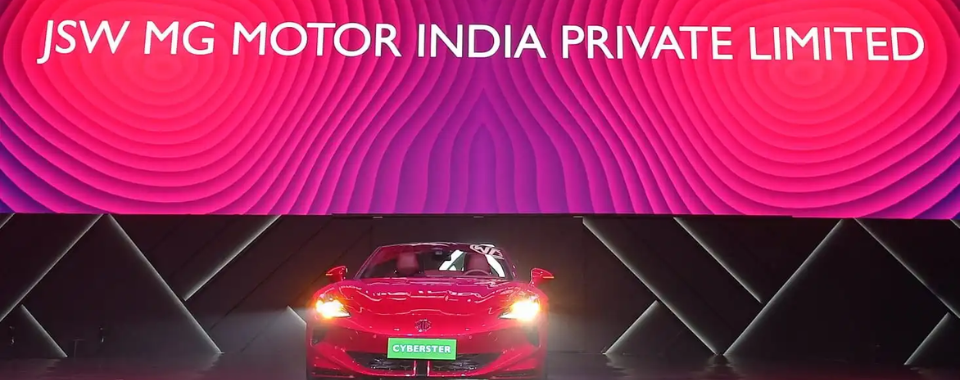
JSW MG India is injecting as much as ₹40 billion (approx. $441 million) over the next few years to expand its manufacturing capacity and shift its product lineup to New Energy Vehicles (NEVs). This is an aggressive move to double its production capacity to 300,000 units per year and gain a leading share in the Indian EV market. This is in the wake of a sharp increase in sales and revenue in 2025, but it comes against the backdrop of doubled losses.
JSW MG India Speeds Up NEV Plans with Significant Investment:
JSW MG Motor India is expected to invest between ₹30 billion and ₹40 billion (around $330 million to $440 million) in the coming years, marking a clear move towards electric and hybrid vehicles. This significant outlay of funds is aimed at doubling the company’s current production capacity to 300,000 units per year and is expected to help the company strengthen its foothold in the fast-growing New Energy Vehicle (NEV) market in India. The investment will be used to enhance production infrastructure and will also support new models being launched from 2027, with three to four models being launched in 2026, including a full electric and a plug-in hybrid.
The Valuation Gap:
The Halol joint venture facility, now running at or near full capacity with 110,000 units of production capacity, experienced a significant boost of 35% in retail sales and a 27% rise in revenue for calendar year 2025, well ahead of the industry’s 5-6% growth rate. JSW MG’s market share in electric vehicles surged to about 30% in 2025 from under 10% two years earlier, mainly driven by its electric multi-purpose vehicle, the Windsor. However, the company’s financials are a different story altogether. The company’s losses for the fiscal year ended March 31, 2025, doubled to $121 million, with cash on hand at around $60 million and debt of $344 million. The parent company, SAIC Motor Corporation (600104.SS), showed a sharp decline in earnings in 2024 , while its P/E ratio is currently around 11.6 as of February 2026 , suggesting a possibly more mature valuation than its growth-oriented competitors. For comparison, rival Tata Motors (TATAMOTORS.NS) has P/E ratios that vary significantly depending on the time frame considered but has managed to register a positive EV EBITDA margin in FY25.
The Analytical Deep Dive:
JSW MG Motor’s ambitious NEV plans are being realized in a rapidly evolving Indian automotive landscape. The Indian automotive industry as a whole is expected to register a growth of 6-8% in 2026, thanks to government policies and rising affordability of passenger cars, especially SUVs, in addition to the rising acceptance of CNG and electric vehicles . The government remains committed to promoting the adoption of EVs through programs such as the PM E-Drive initiative, which has a large outlay and promotes the adoption of millions of EVs, in addition to Production Linked Incentive schemes for batteries and the automotive industry. NEVs are expected to account for 30% of the country’s annual car sales by 2030 .
However, the competitive environment is becoming tougher. Tata Motors, although having a shrinking market share from its erstwhile dominance, is a major player seeking to reclaim its leadership position with a substantial investment in EVs. Mahindra & Mahindra is also diversifying its EV models, although global competitors such as BYD are struggling because of import taxes and geopolitical tensions. JSW MG Motor occupied the second spot in the Indian EV market in January 2026, but its market share is challenged by the country’s behemoths. The company’s focus on NEVs, expected to account for 75-80% of its business, is market-aligned but needs smooth implementation to convert scale into profitability.
The Future Outlook:
The future outlook for JSW MG Motor is based on the company’s plans to capitalize on its increasing sales and NEV offerings to drive profitable growth. The localization plans are intended to improve competitiveness on costs and reduce the impact of foreign exchange fluctuations. The future plans of the company are centered on NEVs contributing largely to their offerings, in line with the overall plans of the Indian government to move towards electrification. Although the investment plan reflects the company’s ambitions, the key to its success will be its ability to deal with challenges related to profitability, competition, and regulatory environments.