



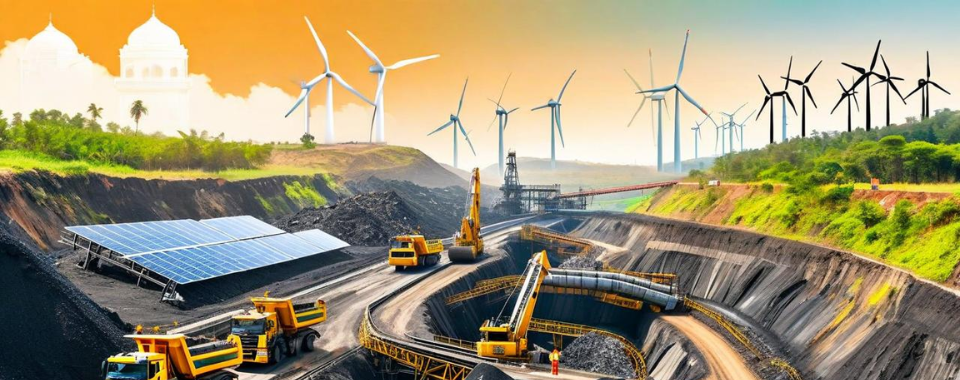
The ambitious target of coal-fired power projects in India is running into operational and investment challenges, with only a small portion of the projects being realized. This is being faced at a time when renewable energy sources, especially solar energy, appear to be rapidly increasing in power generation, enough to meet most of the demand in the coming years.
Global Energy Landscape Shift:
The global trend associated with coal-fired power, which was the backbone of industrialization, now shows indications that it is facing a recession. Use of coal-fired power in developed countries is down by 50% since the last peak that happened two decades ago. Although the downward trend was taken up by China, the growth rate of its coal-fired power also suffered a slowdown of 1% last year, even when the electricity growth rate improved by 5%. The International Energy Agency (IEA) adjusted the forecast downward and now predicts a decline of 180 million tons for the demand of coal-fired power for the period ending 2030.
A Changing Regulatory Landscape in the EU:
A prominent exception is India, which is projected to increase its coal use through to 2030, based on IEA projections. Yet even in this case, there is a questioning of the feasibility of increasing coal power capacity. The government’s plan to increase coal power by a further 97 GW by 2035 is threatened by many hurdles. At the end of 2025, only 35.5 GW of this has received finance approval, and only a meager 16.3 GW has broken ground. Roughly 22 GW of projects have been reportedly shelved because of complications in regulations, politics, or finance. It seems that for a goal of 97 GW to be reached, projects have to be approved at an impossible rate of exactly one every ten days for the next two years. Other than power projects, projects in the non-power segment, such as coal gasification, have been delayed for as many as 11 years for projects such as the Talcher project, even now nowhere near completion.
The Rise of Renewable Energy in India:
Meanwhile, India’s renewable energy sector is seeing rapid overall growth, spearheaded by solar. SBI Capital Markets expects solar installations to reach 50 GW in 2026. This frenetic pace of deployment will be essential if the goal of Prime Minister Narendra Modi to reach 500 GW of clean power capacity by 2030 is to be reached. Current rates of clean power build-out could meet around 97% of projected demand growth to 2030, making significant new coal capacity unnecessary. Residual demand growth could be met through ramping up existing underutilized fossil fuel generators. For example, last year coal power generation in India declined around 3%, of which increased clean generation accounted for a large part. This is important because it means coal generation has fallen for the first time in half a century in both China and India in the same year.
Investor Confidence and Capital Allocation:
The challenges in implementing new investments in coal and also related to the rise in competitiveness of renewables are also impacting investor attitudes. There is a certain level of reservation in private investments in large-scale projects in coal sectors, particularly those which are state-sector and require state support. Around 80% of the existing projects in coal are state-sector and are already under construction, which also marks a certain kind of reliance and can act as a demotivating factor for private investments in the sector. This is also supported by indications from Financial Institutions like SBI Capital Markets that India’s new coal target is unlikely to be achieved by the govt.