


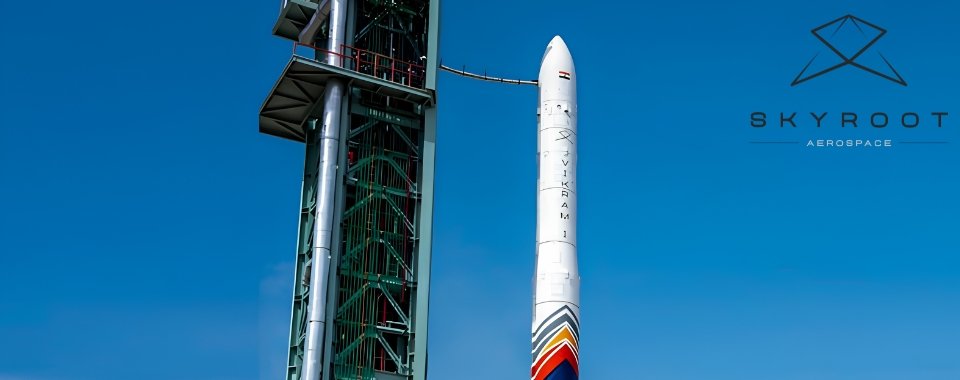
Skyroot Aerospace has made history as India’s first privately owned aerospace company to create, manufacture and launch a rocket into space with the maiden flight of Vikram-1 launch vehicle from the Satish Dhawan Space Centre located at Sriharikota.
In the mission called ‘Aagman’, the rocket took off from the First Launch Pad and entered into its desired low earth orbit at an altitude of 450 km with an inclination of 60 degrees. The rocket successfully delivered various payloads, which included Skyroot’s SCOPE satellite and Grahaa Space’s Solaras satellite besides other payloads.
This makes Skyroot one of those few private companies across the world who have successfully orbited and achieved this feat on their very first attempt at orbital flight.
Validation of key systems during flight:
As per the company, Vikram-1 accomplished all the mission milestones during the flight test. Mission has validated the functioning of the propulsion, avionics, and guidance and navigation control system of the spacecraft in flight conditions.
The launch will provide useful flight data for the future launches of the Vikram series of launch vehicles. Pawan Kumar Chandana, co-founder, and CEO of Skyroot Aerospace, stated that the mission has showcased India’s ability to design launch vehicles for global customers and solidify its presence in the international space domain.
Naga Bharath Daka, co-founder, and COO of Skyroot Aerospace, said that the mission is a result of several years of engineering work and collaboration with industry, customers and other government departments.
Foundation for commercial launch services:
The Vikram-1 is a multi-stage seven-story orbital launch vehicle equipped with an entirely carbon composite body and in-house produced propulsion systems such as 3D-printed engines and solid-fuel rockets. Vikram-1 is meant to transport small satellites weighing no more than 350 kg to Low Earth Orbit.
The mission has carried payload from Grahaa Space, Cosmoserve and DCubed along with some technology demonstration missions and the satellite belonging to Skyroot itself.
The launch will serve as the base for the commercial launch operation of Skyroot as the interest in deploying small satellites grows worldwide.
The company already has plans to develop a bigger launch vehicle called Vikram-2 that will have the capacity to lift 1,000 kg to Low Earth Orbit and its first flight planned for 2027. Skyroot is also working on creating a fully reusable launch vehicle that will decrease the cost of launching by reusing the booster and upper stage of the rocket.
The achievement emphasizes the emerging India as a significant player in the space industry and shows increasing involvement of private businesses in the Indian space sector.