



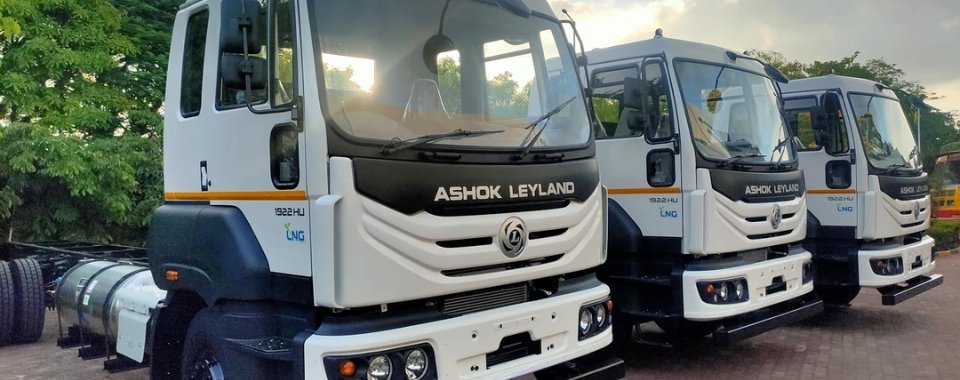
On one particularly profitable day for stocks, Friday, the stocks of Ashok Leyland reported a record hike to an all-new stock price high at ₹194.75 based on record Q2 FY26 results and a bullish outlook for the auto industry. It gained 9.3% more in revenue at ₹9,588 Crores and 14.2% more in EBITDA at ₹1,162 Crores.
Record Earnings Catalyze Stock Surge:
The stock of Ashok Leyland traded at an intraday high of ₹194.75 on Friday, hitting a new high for the company. The stock registered an increase of 2.3% with high trading volumes. The company’s stock hit a new high by increasing to ₹194.75 compared to the previous high of ₹191.80 on January 5, 2026. The company’s stock increased by 40% over the last three months while the stock market reported a fall of 2.6%. In the last six months, the company’s stock increased by 57%, showing a sharp contrast to the fall of 0.5% reported by the stock market. The company’s stock results reveal positive financial numbers and an improving industry scenario for the company.
Q2 FY26 Performance Exceeds Expectations:
The financial performance of the company during Q2 of financial year FY26 (July to September period) saw an exceptional performance in profitability. Earnings Before Interest, Taxes, Depreciation, and Amortization (EBITDA) have touched a new high of ₹1,162 crores during Q2 of this financial year. This marks a growth of 14.2% year on year. The EBITDA also saw an improvement in its margin during Q2 of this financial year to 12.1%. This marks an increase of 50 basis points compared to those of Q2 of the preceding year. Similarly, in Q2 of this financial year, profit before tax touched an all-time high of ₹1,043 crores due to a year-on-year revenue growth of 9.3%.
Positive Industry Tailwinds and Management Confidence:
Ashok Leyland Group has indicated increased vigour in the Medium and Heavy Commercial Vehicles segment in the latter half of the fiscal, driven by a rise in demand due to widespread consumption as well as infrastructure activity. An increased demand for the AC integration available in medium and heavy commercial vehicles indicates a paradigm shift in the preferences of India’s fleet. Lowering the GST rates on new trucks and buses to 18% from 28% has reduced the operating expense for vehicles, along with a hoped-for rise in freight rates due to an improved GST tax structure. The Light Commercial Vehicles segment also indicates strong performance.
Analyst Conviction and Sectoral Growth Narrative:
Analysts at Nomura have upgraded the growth forecast of the Indian MHCV industry to 8% and 10% YoY for FY26 and FY27, respectively, from their previous estimate of 4-5%. The reason behind the recalibration considers the increase in freight rates, improving affordability with lower GST, an ageing commercial fleet-the average age of fleet is approximately 10 years-and pre-buying ahead of regulatory changes. Ashok Leyland, with a significant 31% share in the domestic MHCV market, is well-positioned to gain from this projected upsurge. Commodity prices remain benign, and the firm will see operating leverage kick in for further margin expansion. “We estimate 18% EPS CAGR for Ashok Leyland during FY26-FY28F,” the brokerage firm said in a note. It retains Ashok Leyland as its top pick in the sector, with a target price of ₹196 per share.
Competitive Landscape & Financial Strength:
Other key peers too have reported strong sales numbers for December 2025. Tata Motors’ commercial vehicle sales were up 25% y-o-y at 42,508 units. VE Commercial Vehicles of Eicher Motors posted a gain of 24.7% at 10,384 units. Ashok Leyland’s market capitalisation stood at around ₹1,11,768 crore as of January 21, 2026. The P/E multiple for the company stands at approximately 33.4, while ROE and ROCE are at 28.8% and 14.3%, respectively. The company has a healthy net cash balance of ₹1,000 crore and has also announced strategic investments: setting up a new EV facility at Lucknow and substantial allocation of capital towards battery development.
Future Projections and Sector Momentum:
The industry stands at what most analysts would call the beginning of an upcycle. With positive macroeconomic factors, sustained investment in infrastructure, and other benefits from GST reforms, this demand would continue to build further. Considering Ashok Leyland’s diversified business model, relatively strong market share, and strategic intent on future technologies like electric vehicles, the company is well-positioned to benefit from this growth trajectory. The fact that it has been consistently able to achieve double-digit EBITDA margins, as indicated by its eleventh consecutive quarter of doing so, bears testimony to its operational resiliency and leadership in the marketplace.